Average Car Accident Settlement Amounts in South Carolina: What Your Case May Really Be Worth
Average Car Accident Settlement Amounts in South Carolina: What Your Case May Really Be Worth
06.03.26
If you’ve been hurt in a car accident and you’re searching for settlement averages, here is the most important thing to understand before you read another word:
The average doesn’t tell you what your case is worth. It tells you what uninformed claimants accepted.
Published estimates typically place South Carolina car accident settlements somewhere between $15,000 and $75,000 for moderate injury cases. But those numbers blend minor fender-benders with catastrophic crashes, unrepresented victims who took the first offer with litigated cases that went the distance.
At Mastantuno Law Firm in Charleston, we work with South Carolina accident victims every day who were told by an insurance adjuster that their case was worth far less than it actually was. This guide is our attempt to give you the honest, detailed picture that most legal websites won’t, so you can make an informed decision about your claim.
Why “The Average” Misleads More Than It Helps
South Carolina does not publish official statewide settlement averages. The estimates you find online are drawn from reported verdicts, industry surveys, and attorney data, and the variance is enormous.
That so-called “average” includes:
Soft tissue cases where an unrepresented claimant accepted $4,500 from an insurer three weeks after the crash
Rear-end collisions with minor treatment and no lost wages
Catastrophic injury cases worth $1 million or more that skew the number upward
A 45-year-old with a lumbar disc injury requiring surgery, six months of missed work, and permanent nerve damage has a case that looks nothing like a 22-year-old with two weeks of chiropractic care and no lasting symptoms.
What Actually Determines Your Settlement Value
South Carolina personal injury law allows accident victims to recover compensation across several distinct categories of damages.
Medical Expenses — Past and Future
Your medical bills form the foundation of your claim.
Every dollar spent from the moment of impact forward is recoverable, including:
Emergency room treatment and ambulance transport
Surgery, hospitalization, and specialist consultations
Physical therapy, chiropractic care, and rehabilitation
Prescription medications and medical equipment
Projected future medical costs
If your injuries require future surgery, ongoing pain management, or long-term physical therapy, those costs belong in your claim.
Lost Wages and Loss of Earning Capacity
If your injuries prevented you from working, even for two weeks, you are entitled to recover that income.
Lost wage claims include:
All wages, salary, or hourly pay missed during recovery
Sick days and PTO you were forced to exhaust
Lost bonuses, commissions, or self-employment earnings
Loss of future earning capacity when injuries permanently affect your ability to work
Calculating that loss properly requires vocational experts and economic analysts, professionals that a well-resourced personal injury firm will engage on your behalf.
Pain and Suffering
Pain and suffering, classified under South Carolina law as non-economic damages, compensates you for harms that don’t come with a receipt.
These damages may include:
Physical pain, both past and ongoing
Emotional distress, anxiety, and post-traumatic stress
Loss of enjoyment of life
Inability to participate in activities, hobbies, or relationships you valued before the crash
Sleep disruption, depression, and chronic pain syndrome
South Carolina imposes no cap on pain and suffering damages in standard car accident cases.
There is no ceiling.
How Is Pain and Suffering Calculated?
The most common method is a multiplier applied to economic damages.
Your total medical bills and lost wages are multiplied by a factor, typically between 1.5 and 5, that reflects the severity and permanence of your injuries.
A soft tissue injury with a full recovery might warrant a 1.5 multiplier.
A permanent disability or disfigurement may support a 4 or 5 multiplier.
Example:
$50,000 in medical bills and lost wages multiplied by a factor of 3.5 produces $175,000 in pain and suffering damages.
The total damages figure becomes $225,000 before any negotiation begins.
Property Damage
Vehicle repair or replacement is a separate recoverable category.
Insurance companies sometimes use early property damage settlements as leverage to get you talking about your injury claim before you understand its full value.
Punitive Damages
In cases involving drunk driving, extreme speeding, street racing, or other conduct that reflects a conscious disregard for human life, South Carolina courts can award punitive damages.
They are designed to punish the defendant’s conduct and deter similar behavior in the future.
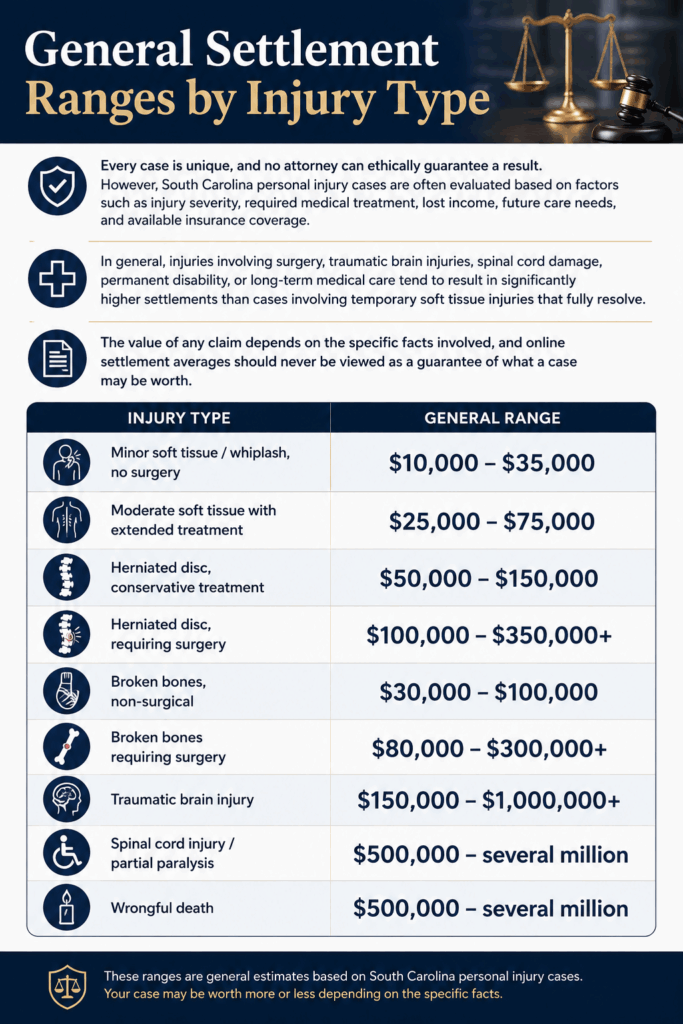
General Car Accident Case Settlement Ranges by Injury Type
In general, injuries involving surgery, traumatic brain injuries, spinal cord damage, permanent disability, or long-term medical care tend to result in significantly higher settlements than cases involving temporary soft tissue injuries that fully resolve.
The value of any claim depends on the specific facts involved, and online settlement averages should never be viewed as a guarantee of what a case may be worth.
South Carolina’s Comparative Negligence Law and What It Means for Your Recovery
South Carolina follows a modified comparative negligence rule under S.C. Code § 15-38-15.
In plain terms:
If you are 50% or less at fault, you can recover damages, but your award is reduced proportionally by your share of fault.
If you are 51% or more at fault, you are barred from any recovery.
Example:
A jury awards you $100,000 but finds you 20% at fault for following too closely. Your net recovery would be $80,000.
Insurance adjusters use comparative fault aggressively. They will look for any evidence, including a dashcam angle, a prior statement, or a witness account, that assigns you partial responsibility for the crash.
At Mastantuno Law Firm, we anticipate these arguments from the start and build our case to counter them with the evidence needed to hold the at-fault driver fully accountable.
The Insurance Company’s Playbook — and How to Counter It
Why First Offers Are Almost Always Too Low Initially
An insurance adjuster’s job is to close claims as cheaply as possible.
Common tactics include:
Early contact before you understand the full extent of your injuries
Recorded statements that may later be used against you
Quick releases that permanently waive your right to additional compensation
Attempts to minimize future medical treatment and long-term damages
Signing a release before you reach maximum medical improvement, the point at which your doctors understand the long-term effects of your injuries, can be one of the most costly mistakes an accident victim makes. Once signed, it generally cannot be undone.
Policy Limits
South Carolina requires drivers to carry minimum liability coverage of:
$25,000 per person for bodily injury
$50,000 per accident for bodily injury
When available coverage is limited, additional recovery strategies may become important, including:
Umbrella insurance policies
Employer vehicle coverage
Commercial insurance policies
Uninsured motorist coverage
Underinsured motorist coverage
Uninsured and Underinsured Motorist Coverage in South Carolina
South Carolina law requires insurers to offer uninsured motorist (UM) and underinsured motorist (UIM) coverage to policyholders.
This coverage helps protect you when:
The at-fault driver has no insurance
The at-fault driver’s insurance limits are insufficient to cover your losses
For example, imagine a driver rear-ends you on I-526 and carries only the state minimum insurance limits. If your medical bills alone exceed those limits, your own UM or UIM coverage may provide additional compensation.
Local Conditions That Could Affect Your Claim
Charleston, SC has become one of the busiest driving environments in South Carolina. Population growth, seasonal tourism, and aging infrastructure contribute to an increased number of crashes throughout the region.
Key Charleston Accident Corridors
I-26 and Ashley Phosphate Road
This area has a long history of serious traffic accidents and remains one of the state’s most heavily traveled intersections.
I-526 and US-17
These corridors experience significant tourist traffic, especially during peak vacation seasons. Accidents involving out-of-state drivers can introduce additional insurance and jurisdictional complexities.
Port of Charleston Truck Traffic
Commercial trucks moving through the Port of Charleston create additional risks on I-26 and surrounding roadways.
Commercial vehicle accidents often involve:
Higher insurance limits
Federal trucking regulations
Multiple liable parties
More extensive investigations
Downtown Charleston Pedestrian Areas
Locations such as King Street and The Battery experience heavy pedestrian activity.
How Much Will You Actually Take Home?
Gross settlement figures are not the same as the amount that ultimately reaches your bank account.
Several deductions may apply, including:
Attorney fees
Medical liens
Medicare or Medicaid reimbursement claims
Case expenses such as expert witness fees and court costs
Example
A $150,000 settlement could include:
$40,000 in attorney fees
$25,000 in medical liens
$5,000 in litigation expenses
In that scenario, the net recovery would be approximately $80,000.
This is not a reason to avoid pursuing a claim.
Instead, it highlights the importance of understanding the full financial picture before accepting a settlement offer.
Experienced attorneys often negotiate medical liens and reimbursement claims, helping clients maximize the amount they ultimately keep.
Frequently Asked Questions
What is the average car accident settlement in South Carolina?
Most South Carolina car accident settlements range from $15,000 to more than $100,000 depending on injury severity, fault allocation, and available insurance coverage.
Serious injury cases involving surgery, permanent disability, or substantial lost income may result in significantly larger recoveries.
Does South Carolina cap pain and suffering damages?
No.
South Carolina does not impose a cap on non-economic damages in standard car accident cases.
Can I recover compensation if I was partially at fault?
Yes.
As long as you are 50% or less at fault, South Carolina law allows you to recover compensation. Your recovery will be reduced by your percentage of fault.
Should I accept the insurance company’s first settlement offer?
In most cases, no.
Initial settlement offers are often significantly lower than the full value of a claim.
Before accepting any offer, consider speaking with an attorney who can evaluate your damages and future needs.
What if the other driver had no insurance?
Your uninsured or underinsured motorist coverage may provide compensation.
Many drivers are surprised to learn that their own policy may offer protection in these situations.
How does a pre-existing condition affect my claim?
South Carolina follows the “eggshell plaintiff” doctrine.
If an accident aggravates a pre-existing condition, you may still be entitled to compensation for the worsening of that condition.
How long does a South Carolina car accident settlement take?
Some claims resolve within a few months.
More serious cases involving extensive treatment, disputed liability, or litigation may take one to three years or longer.
What is the deadline to file a car accident lawsuit in South Carolina?
In most cases, South Carolina’s statute of limitations is three years from the date of the accident.
Failing to file within that timeframe can permanently bar your claim.
Contact Mastantuno Law Firm for a Free Consultation
If you’ve been injured in a car accident anywhere in South Carolina, whether on I-26, I-526, US-17, or another roadway, understanding the true value of your claim is critical before accepting any settlement offer.
Before signing a settlement agreement or providing additional information to an insurance company, consider speaking with an experienced personal injury attorney.
We offer free consultations and work on a contingency fee basis. Contact us today
Trustindex verifies that the original source of the review is Google.
Great lawyer! Helped me when I really needed it.
Posted on Google
William Drew
Trustindex verifies that the original source of the review is Google.
This is your man! Thank you Mr.Mastantuno your professionalism and patience helped me in a time of confusion.
Posted on Google
Carol Bruton
Trustindex verifies that the original source of the review is Google.
It was a great experience. Everyone was very professional and kind. Attorney Mastantuno 'just handled the business'. He did a fantastic job!
Posted on Google
Daunte Hall
Trustindex verifies that the original source of the review is Google.
Great attorney that will go to bat every time for his client I would give more stars if I could thanks Allen from Mr.Leslie.
Posted on Google
Caroline M Pettigrew
Trustindex verifies that the original source of the review is Google.
Allen was very professional, informative, and kind throughout my DUI case. He was attentive and regularly responsive to my emails and phone calls! Allen took a very bad, bad situation and got a very good, good result! I can’t thank him enough!
Posted on Google
Geisy Adriany De Almeida Barbosa
Trustindex verifies that the original source of the review is Google.
Super indico
Posted on Google
Chalo Hernandez
Trustindex verifies that the original source of the review is Google.
This place got me the information I needed quick and easy.
Posted on Google
DeeCeeCover s
Trustindex verifies that the original source of the review is Google.
This is a very knowledgeable lawyer who is easy to work with and gets back to you in a timely manner.
Posted on Google
Sam F
Trustindex verifies that the original source of the review is Google.
Allen represented me in an accident case in which he did a fantastic job. First of all he gave me more money off of the total than he was required to. In the beginning of a criminal defense case, that he is also handling for me, he worked with me on the fees and was way more than patient. Can’t say enough good things about him as a professional and a person with integrity. Y’all, hire him! Highly recommended!


 MENU
MENU